Exploring EEG and ECG in music listening.
Eighteen studies recorded the brain and the heart at the same time while people listened to music. Only a small subset of them analysed the two together. That is the finding, and it is the gap.
The short version
Music moves the body as well as the mind. EEG captures the brain's response to a piece of music as it unfolds, millisecond by millisecond. ECG captures what the heart does over the same seconds, and the heart-rate variability derived from it reflects the autonomic balance that accompanies changes in arousal and emotion. Read on their own, each signal is ambiguous. A shift in cortical alpha might mean stimulus processing or it might mean a general change in arousal. A change in heart rate might be emotion, or it might be a change in breathing or posture.
Recorded together, the two can be cross-referenced. That is what makes concurrent recording worth doing, and it is why we went looking for studies that had done it.
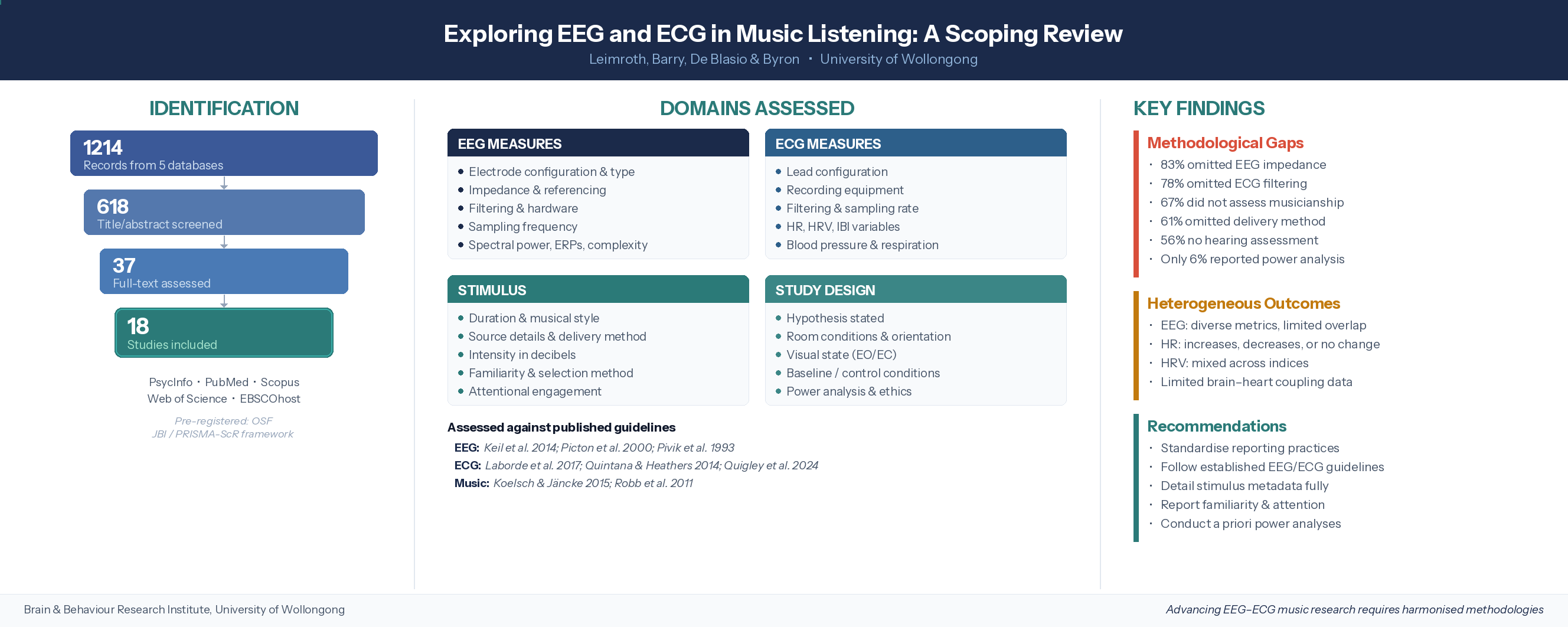
We searched five databases for peer-reviewed studies that recorded EEG and ECG concurrently during passive music listening in healthy adult non-musicians, and compared what we found against published methodological guidelines. Eighteen papers met the criteria.
What we found
Every study our search found that recorded EEG and ECG concurrently during passive music listening in healthy adult non-musicians.
Fifteen of the eighteen did not mention electrode impedance levels, and ten did not specify the electrode type used.
Only two studies included time-domain measures of heart rate variability, the most basic cardiac index available.
EEG findings were heterogeneous, spanning spectral power, lateralised effects and event-related potentials, with limited overlap in analytical focus. Cardiac outcomes were similarly mixed, with studies reporting increases, decreases or no change in heart rate depending on the stimulus and the context.
The variability is itself informative. It does not simply reflect the fact that people respond to music differently. It reflects a research field that has not yet settled on shared methodological standards, which makes findings hard to compare and harder to replicate.
The gap that matters
Only a small subset of the eighteen studies examined brain-heart coupling directly. Those that did offered preliminary evidence of synchronisation between neural and cardiac rhythms during music listening, which is encouraging. But it leaves the central question largely open. How do the brain and heart respond together to music?
This is the odd part. These studies went to the trouble of recording both signals, which is the hard and expensive half of the work, and then in most cases reported them separately. The covariation between the two, which is the thing neither signal can show alone, mostly went unanalysed.
Alongside that, none of the eighteen provided the score, the audio files, or links to them. For a research area whose independent variable is a piece of music, that is a significant gap in methodological transparency, and it makes direct replication of these studies impossible.
What should happen next
Advancing this work is a matter of three mature research traditions meeting properly. EEG research has well-established reporting guidelines. Cardiac psychophysiology has its own. Music research has conventions for describing the stimulus. A study at the intersection has to satisfy all three at once, and most of the studies we reviewed didn't.
Few people are trained in all three, and that shows in the reporting. Researchers arrive from one tradition and are often unfamiliar with what the others ask for. Our own team spans music research and psychophysiology, and even between us the review kept turning up terms one discipline takes for granted that another reads differently. That friction improved the review, and it's a fair description of why the gaps in the literature look the way they do.
Three things would change the picture quickly: report the EEG acquisition parameters that the existing guidelines already ask for, include time-domain as well as frequency-domain cardiac measures, and share the musical stimuli so that a result can be tested by someone else. All of it is ordinary. It is the difference between a set of interesting individual findings and a literature that accumulates.
Read the paper
The review followed the Joanna Briggs Institute methodology for evidence synthesis and the PRISMA extension for scoping reviews. The protocol was determined a priori and preregistered before the search was run. The article is open access under a Creative Commons Attribution 4.0 licence, so it can be read, downloaded and redistributed by anyone.
Use the review
The review's charted data is now a small open-source tool: ask it questions on the page and get an answer sourced from the paper itself, screen a study against its eligibility criteria, check your own reporting against the same items the 18 included studies were charted on, or hand the paper to your own AI assistant instead.
Built with the Paper2Agent method of Miao, Davis, Zhang, Pritchard and Zou (2026), Reimagining research papers as interactive and reliable AI agents, Nature.
Details
- JournalPsychophysiology, 63(9), e70385
- Published3 September 2026
- DOI
- PubMed
- Licence
- ORCID
- InstitutionBrain & Behaviour Research Institute, School of Psychology, University of Wollongong